
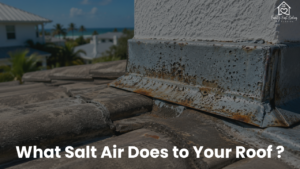
Living near the Florida coast is a lot of things beautiful, breezy, and peaceful. But if you own a home within a few miles of the water, that same ocean breeze is quietly working against your roof every single day. Salt air doesn’t look like damage. It doesn’t sound like anything. It just shows up, settles in, and starts breaking things down in ways most homeowners don’t notice until the problem is already expensive.
It’s not just humidity salt is its own problem.
Florida homeowners know humidity is hard on a house. But salt air is different. Regular moisture evaporates. Salt doesn’t. It lands on your roofing materials, bonds to the surface, and pulls in more moisture every time the air gets humid which, in Florida, is most of the time.
That cycle repeats itself constantly. Day after day, season after season. And it’s not picky about what it attacks. Shingles, metal panels, wood decking, and especially the metal components of your roof system all of it is fair game.
What Happens to the Metal on Your Roof
This is where salt air does its most visible damage, and it usually starts with flashing.
Flashing is the metal that seals the joints on your roof around the chimney, along the edges, where different roof planes meet, around vent pipes and skylights. It is an important job. When it fails, water gets in. And salt accelerates that failure faster than most people expect.
Corrosion starts at the edges and seams. You might see a reddish-brown discoloration first, or a white powdery residue if the metal is aluminum. Either way, it means the protective surface is breaking down. Once corrosion sets in, the metal gets thinner, joints open up, and the seal that was keeping water out is gone.
On coastal homes, flashing that might last 20 years inland can start failing in 8 to 10. That’s not a flaw in the materials it’s just what salt air does when it’s present year-round.
Pitting Damage: The Problem You Can’t See from the Ground
Pitting damage is one of the more frustrating effects of salt exposure because it looks minor from a distance. Up close, it’s a different story.
Salt particles are abrasive. Over time, they wear tiny craters into roofing surfaces, especially metal roofing and metal fasteners. These small pits don’t just look bad. They trap moisture, accelerate corrosion from the inside out, and create weak points that fail during storms. A fastener that’s been pitting for five years looks fine until a strong gust tests it.
On asphalt shingles, pitting damage combines with UV exposure and heat to strip granules faster than normal. The protective layer thins out unevenly. You’ll see bald patches in some areas while other sections still look decent. That inconsistency is actually a warning sign the roof is aging at different rates, and the bare spots are the first to leak.
Why Coatings Matter More on Coastal Homes
If you live in land Florida, protective coatings on your roof are a nice extra. If you live near the coast, they’re closer to a requirement.
Good coatings create a barrier between your roofing materials and the salt-laden air. On metal roofing, factory-applied finishes and field-applied sealants slow down corrosion significantly. On asphalt shingles, reflective coatings and sealants help hold granules in place and reduce the UV damage that salt exposure makes worse.
The catch is that coatings don’t last forever, especially in coastal conditions. They need to be inspected and reapplied on a schedule. A coating that’s cracked or peeling isn’t protecting anything, it’s just sitting there looking like it is. Part of maintaining a coastal roof is treating the coatings as a regular maintenance item, not a one-time fix.
How Close Is Too Close?
There’s no hard line, but most roofing professionals use roughly a mile to three miles from the shoreline as the zone where salt air exposure becomes a real factor in how you maintain and replace your roof.
Within a half mile of the water, the effects are the most aggressive. Flashing corrodes faster, coatings degrade sooner, and the inspection interval you’d use for an inland home isn’t enough. Twice-a-year inspections are not overkill for homes in this range. They’re the baseline.
From one to three miles out, the effects are present but slower. You still need to pay attention to the metal components, keep coatings in good shape, and get a professional eye on the roof before and after hurricane season. Beyond three miles, you’re mostly dealing with standard Florida humidity concerns still significant, but less acute than what a beachfront home faces.
What You Should Do Right Now
If your home is in a coastal zone and you haven’t had a professional roof inspection recently, that’s the first step. Salt damage is cumulative. The longer it goes unaddressed, the more it costs to fix.
A good inspector will check the flashing specifically, they’re the first-place salt air wins. They’ll look at the condition of any coatings on the metal components, check out fasteners for pitting damage, and assess whether the shingles or panels are aging at the rate you’d expect for your climate zone.
The goal isn’t to panic about living near the water. It’s to maintain your roof on the schedule that your actual climate demands not the one that works fine for a house in north Georgia.
We work with coastal homeowners across Florida. The ones who stay ahead of salt damage aren’t spending more money overall they’re just spending it smarter and not dealing with emergency repairs after every major storm.
FAQ
- How does salt air specifically damage a roof?
Salt air damages roofs through a moisture-cycling process that never fully stops. Salt particles on roofing surfaces and bond there. They pull in humidity, stay wet longer than plain moisture would, and drive corrosion, pitting, and material breakdown from the surface down. The metal components flashing, fasteners, gutters, and any exposed metal trim corrode faster. Shingles loose granules sooner. Sealants and coatings degrade more quickly. The overall lifespan of every roofing material shortens the closer you are to the shoreline. - How often should coastal Florida homes get roof inspections?
Twice a year is a reasonable minimum for homes within a mile or two of the water. Before hurricane season (late spring) and after it ends (late fall) are the most practical timing points. Homes right on the water within a half-mile benefit from annual or semi-annual inspections that specifically focus on the metal components and coatings, since that’s where salt air does its fastest work. Interior inspections from the attic are also worth doing periodically to catch water intrusion from failing flashing before it shows up on the ceiling. - Do coatings actually help against salt air damage?
Yes, meaningfully so but only when they’re maintained properly. Intact coatings create a physical barrier between the roofing material and the salt-laden air, slowing corrosion on metal and slowing granule loss on asphalt shingles. The problem is that coatings in coastal conditions don’t last as long as they do inland. A coating that was applied five years ago on a beachside home may already be cracked or thin. Have the coating condition checked during inspections, and plan to reapply on a more aggressive schedule than the manufacturer’s standard recommendation if you’re in a high-exposure zone. - What is pitting damage on a roof and is it serious?
Pitting damage is surface-level cratering caused by the abrasive action of salt particles over time. It’s most visible on metal roofing panels and metal fasteners. The pits look small and may not seem serious, but they trap moisture and create points where corrosion accelerates from the inside out. Fasteners with pitting damage can lose structural integrity gradually, which matters a lot when a storm is testing them. It’s also a signal that the protective surface coating has failed in those areas. Left alone, pitting progress getting it addressed early is much less expensive than replacing structural components later. - Are some roofing materials better for coastal Florida homes?
Aluminum-based roofing and aluminum fasteners outperform steel in salt air environments because aluminum doesn’t rust the same way steel does. Standing seam metal roofing with factory-applied Kynar or similar PVDF coatings is considered one of the more durable options for coastal conditions. Concrete and clay tile also hold up well because they don’t corrode. Standard galvanized steel flashing is a weak point it should be upgraded to aluminum or stainless steel on homes with significant salt exposure. Asphalt shingles can work but need to be on a shorter inspection and maintenance schedule than they would inland.