
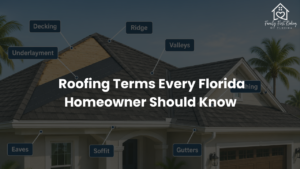
At some point, a roofer is going to walk around your house and start talking. They’ll say things like “your decking looks soft near the valley” or “we need to re-flash that chimney.” And if you don’t know what any of that means, you’re nodding along and hoping for the best. That’s not a great place to be when someone’s quoting you thousands of dollars.
This glossary isn’t meant to turn you into a contractor. It’s just enough to follow the conversation, ask the right questions, and understand what you’re paying for. In Florida, especially where roofing takes a beating from heat, humidity, and storms knowing this stuff matters.
The Bones of Your Roof
Decking (also called Roof Sheathing)
This is the flat surface that everything else gets attached to. It’s usually plywood or OSB board, and it sits directly on top of your roof trusses or rafters. Decking is what gives your roof its structural base.
In Florida, decking is vulnerable to moisture damage. If water gets under your shingles long enough, the decking softens, warps, or rots. You can’t always see it from outside, but a good roofing inspection will include checking for soft spots. When decking fails, it’s not optional to replace it, it must go before anything else does.
Trusses and Rafters
This is the wooden framework underneath the decking. Trusses are the pre-built triangular support that most newer Florida homes use. Rafters are the older style individual beams cut and assembled on-site. Either way, they hold everything up.
Ridge
The ridge is at the very top of the roof, the horizontal line where two slopes meet at the peak. You’ll often see ridge vents running along it to let hot air escape from the attic.
The Layers That Do the Real Work
Underlayment
Think of underlayment as a backup system. It goes down on top of the decking before the shingles or metal panels go on. Its job is to keep water out if the outer layer gets damaged which in Florida, during a hurricane, is a real scenario.
There are two main types you’ll hear about: felt underlayment (older, cheaper) and synthetic underlayment (more durable, better water resistance). There’s also self-adhering underlayment, sometimes called a secondary water resistance barrier, which is one of the most valuable roofing upgrades for Florida homes. It sticks directly to the decking and seals around nail holes which matters a lot when wind-driven rain is coming on your roof sideways.
Flashing
Flashing is metal, usually aluminum or galvanized steel installed anywhere the roofing surface meets something else. Chimneys, skylights, vent pipes, walls, and dormers all need flashing to seal the gaps that would otherwise let water in.
It’s one of the most failure-prone parts of a roof, not because flashing is a bad idea, but because it takes more abuse than most people realize. In Florida, salt air near the coast corrodes flashing faster. Heat expansion and contraction work the seals loose over time. When a roofer tells you the flashing needs attention, don’t put it off; that’s usually where leaks start.
The Shape of Your Roof
Eaves
The eaves are the edges of the roof that overhang past the exterior walls. They create shade along the sides of the house and channel rain away from the foundation. In Florida, wide eaves are common and helpful to keep direct sun off the exterior walls and reduce rain runoff against the siding.
Eaves also matter for ventilation. Soffit vents are typically installed on the underside of the eaves to pull cooler outside air into the attic.
Valleys
A valley is where two roof slopes meet and form a V-shape. Valleys carry a lot of water during rain more than any other part of the roof surface. That’s why they need extra protection. Roofing contractors typically run a strip of underlayment or a specialty liner underneath the shingles in these areas. When valleys start to fail, leaks follow fast.
Hip Roof vs. Gable Roof
You’ll hear these terms in Florida, often in the context of insurance. A hip roof slope on all four sides. A gable roof has two slopes and flat triangular end walls. Hip roofs perform significantly better in high winds; the shape deflects wind rather than catching it. Most Florida insurers offer meaningful discounts for hip roofs, which is worth knowing if you’re ever replacing your roof and have a choice about design.
Terms You Might Not Expect to Hear in Florida
Gutters
Gutters aren’t technically part of the roofing system, but they’re directly tied to how well your roof performs. They catch water running off the eaves and direct it away from the foundation. In Florida, clogged gutters are a major cause of water backing up under the roofline and causing rot at the fascia and soffit. Getting your gutters cleaned at least twice a year if you have heavy tree coverage is part of maintaining your roof properly.
Soffit and Fascia
The soffit is the finished underside of the eaves. The fascia is the board running along the edge of the roof where the gutters attach. Both are exposure points for moisture, and both can show damage before the roof itself does. Soft fascia boards are often a sign that gutters have been overflowing for a while.
Pitch (Roof Slope)
Pitch describes how steep your roof is, usually expressed as a ratio like 4:12, which means the roof rises 4 inches for every 12 inches of horizontal distance. Low-pitch roofs are common in older Florida homes and commercial buildings. They shed water more slowly, so drainage matters even more. Steeper roofs shed water faster and dry out quicker after heavy rain.
Why Any of This Matters in Florida
Roofing in Florida isn’t the same as roofing elsewhere. The heat, the humidity, the storm season, and in coastal areas the salt air, all of it puts more stress on every part of the system. Knowing what the parts are called helps you follow the inspection report. It helps you understand the quote. And it helps you know when something a contractor says doesn’t add up.
You don’t need to know everything. But knowing enough to have a real conversation is worth a lot when someone’s telling you what your roof needs.
FAQ
- What is underlayment and why does it matter in Florida?
Underlayment is the protective layer installed on top of the roof decking before the shingles or metal panels go on. It acts as a secondary water barrier if the outer surface gets damaged. In Florida, this matters more than in most states because of how severe storms can be. When wind removes shingles during a hurricane, the underlayment is the only thing standing between open decking and heavy rain. Self-adhering synthetic underlayment also called a secondary water resistance barrier is the recommended option for Florida homes because it seals around fastener holes and resists wind-driven water penetration far better than traditional felt underlayment. - What does flashing do and how do I know if mine is failing?
Flashing seals the joints where your roofing surface meets another structure, chimney, skylights, walls, vent pipes. Without it, those gaps let water straight in. Flashing fails when the metal corrodes, when sealants break down from heat cycling, or when the original installation wasn’t up to Florida’s climate demands. Signs of failing flashing include rust or white corrosion staining on the metal, water stains on interior ceilings near chimneys or skylights, or visible gaps where the flashing meets the roof surface. Any of those is worth a professional look sooner rather than later. - What is the difference between eaves and valleys on a roof?
Eaves are the horizontal overhanging edges of the roof, the parts that extend past the exterior walls of the house. They carry water outward and down into the gutters. Valleys are the internal V-shaped channels where two different roof slopes meet and converge. Both are high-traffic areas for water movement during rain, but they serve different functions. Eaves direct water away from the structure. Valleys collect water from multiple slopes and funnels downward. Both need to be in good shape, eaves for gutter connection and overhang protection, valleys because the concentrated water flow makes them a common starting point for leaks. - Is decking damage serious, and can it be repaired without a full roof replacement?
Decking damage is more serious than surface shingle damage because it’s structural. The decking is the base everything else sits on. When moisture gets into the plywood or OSB and causes rot or softening, the affected sections must be replaced before any new roofing material can go on top. In some cases, only a section of the decking needs to come out, not the whole roof. But you can’t skip it or patch it over. The good news is that a professional inspection can usually identify how widespread the damage is, which helps you understand the scope of the repair and the actual cost involved. - Do gutters really affect roof health, or are they a separate issue?
They’re more connected than most people think. When gutters clog or pull away from the fascia, water backs up along the roofline instead of draining away. That standing water soaks into the fascia board, works under the soffit, and can eventually reach the roof decking. Over time, this causes rot in the fascia, moisture damage in the soffit, and in worse cases, water intrusion into the attic space. In Florida, where heavy rain is frequent and debris from palms and oaks fills gutters quickly, twice-yearly cleaning is the standard minimum. Homes with a lot of tree coverage often need it three or four times a year to stay ahead of it.